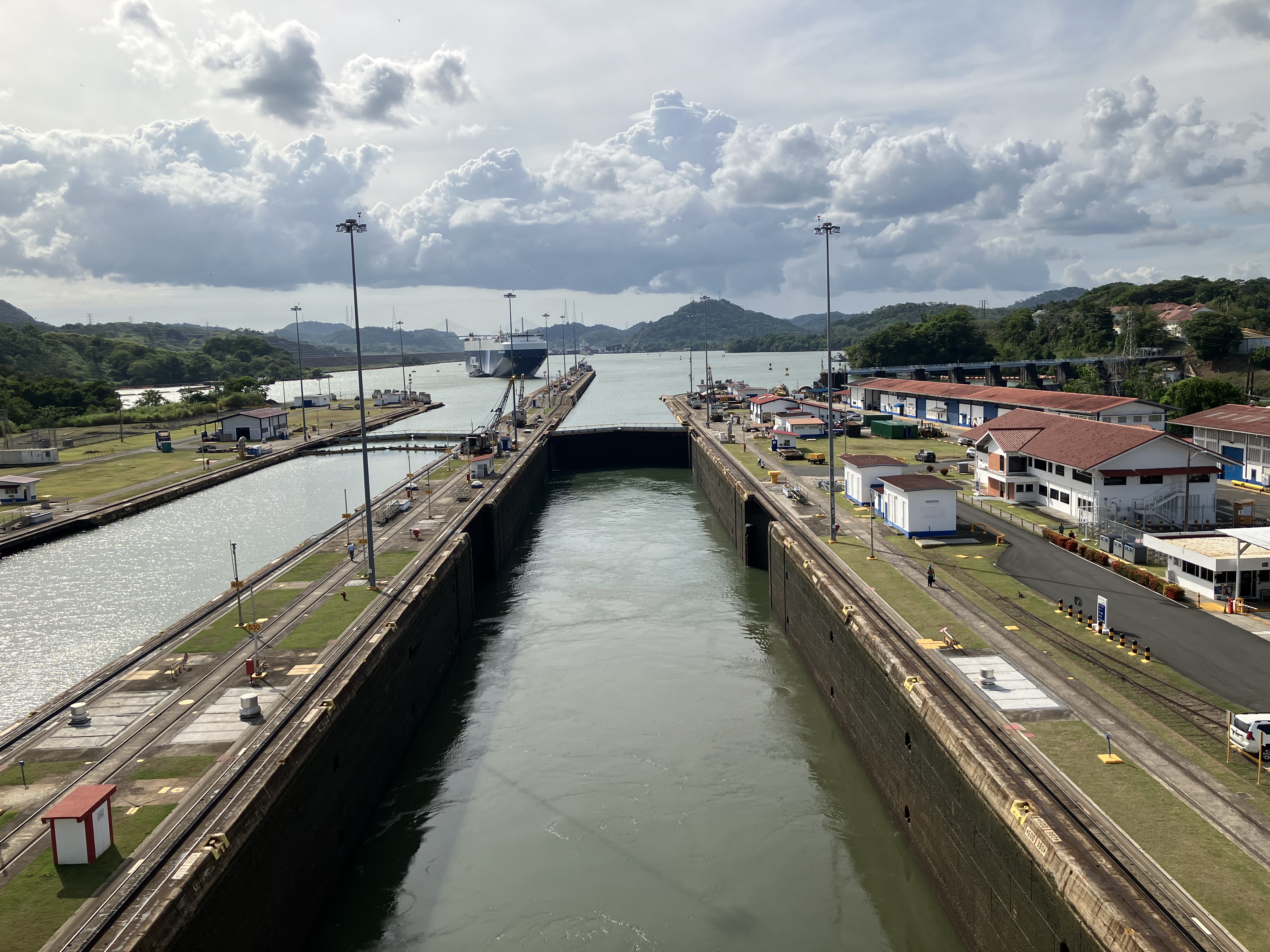
This is a picture of the western end of the Panama Canal. That is the Pacific Ocean ahead.
I've always been somewhat interested in the Panama Canal, but especially after I read The Path Between the Seas, by David McCullough. He's my favorite author. He's written John Adams, Truman, 1776, etc. I've read all his books. If I had access to any of his high school English papers, I'd read those to. I read his Panama book at least a decade ago and then I reread it before my cruise. Its pretty hefty and maybe goes into a little more detail than one would need, but it's really good.
The story of the canal was interesting. The French had built the Suez Canal previouosly and wanted to do the same through Panama (or maybe Nicaragua - more on that later). The Suez Canal meant sailing from, say Rome to India way easier rather than going around Africa - Same with Panama, except here it saved going around South America. Even with the costs, it was a big money and time saver.
However, for tthe Suez Canal, the land was relatively flat and they were basically digging through sand. In Panama, it was not at all flat and it meant carving a path through mountains. Plus Panama had rough diseases like yellow fever and malaria.
France hung in there for many years, but ultimately failed. Thousands died from disease and an awful lot of money was spent. They left the beginnings of a canal and a lot of rusting equipment. They sought to dig all the way down to sea level rather than use a lock system. That was simply not going to work because there was too much mountain to move.
So then the U.S. gave it a shot. At the time, the land was actually owned by Columbia. They weren't crazy about a canal, but if there was a revolution and Panama became its own country, they would probably be more cooperative. That's luckily what happen. OK, not exactly luck. The US was backing the coup so they could get their canal. The U.S. cut a deal with Panama. There was a thought that Nicaragua might be a better spot to dig.
The French failed with the Panama Canal. Its kind of like Vietnam where the French failed then the United States comes in, only the Panama Canal excursion went quite a bit better than Vietnam did.
Panama was actually part of Columbia. Columbia didn't want the United States coming in and building a canal. So the U.S. and Teddy Roosevelt, who I think was a great president except for this, not so secretly supported a coup. Panama became its own country and agreed to have the U.S. come in. Some in the U.S. wanted the canal to go through Nicaragua. Its not as mountainous. It is wider but has a giant lake in the middle which would reduce the amount of digging. It was rumoured that they had occasional volcanic eruptions. That was supported by the fact that their stamps had an actual volcano pictured on them.
So Panama became independent and let the U.S. start building. A big advantage the U.S. had was to go with the lock system rather than trying for a sea level canal. Digging down to sea level just probably wasn't possible. Even today there is constant dredging going on from the ssides of the canal eroding.
Another key was stopping the deaths from malaria. A Dr. Gorges realized it was spread by mosquitos and they proliferate where there is standing water. So he got rid of standing water. They used to put the legs of beds in buckets of water to keep ants from climbing up them. He got rid of those and he made sure all windows had netting on them. Pretty soon malarial deaths went from the thousands to a handful.
The other things that worked was to dam up a river to create a giant manmade lake. Then a lot of the canal didn't even need to be dug, and the electricity from the dam was used to power the locks. Pretty smart.
Even with that, it took a decade or so to build the canal. Worth it, because now people like me get a fun vacation going through it.